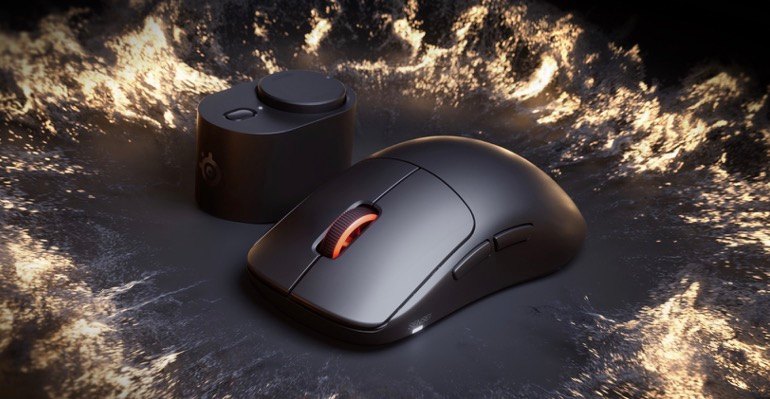
SteelSeries will release the Rival Pro, Sensei Pro and their Mini variants at retail on October 13 for $179.99, €199.99 or £169.99. All four use UWB wireless, an 8,000Hz polling mode, a TrueMove 42K sensor and two hot-swappable batteries. The headline specifications are nearly identical, so the useful buying decision begins with hand shape rather than sensor numbers.
NexusGG did not test these mice. Manufacturer performance claims are identified as claims; feel and fit observations come from PC Gamer and Tom’s Guide reviewers who used pre-release units for extended periods.
Rival is ergonomic; Sensei is symmetrical
Rival Pro continues the right-handed Rival family with an asymmetric hump and thumb-side contour. Sensei Pro uses the lower, symmetrical lineage associated with the original Sensei. Full-size models weigh 53g, while Mini versions weigh 49g. That four-gram saving matters less than whether the shell supports the user’s grip without forcing the wrist or fingers into position.
Tom’s Guide reports that both shapes feel strong in hand and frames the Sensei as the symmetrical sibling. PC Gamer’s Rival Pro review is especially positive about the renewed competitive shape. Those conclusions are useful but not universal: mouse comfort depends on hand length, width and grip style, so buyers should not select a shell solely because a reviewer preferred it.
UWB and batteries explain the price, but not every player needs 8K
SteelSeries says its UWB connection uses the 6.4GHz–9.056GHz spectrum to avoid crowded 2.4GHz traffic. At 8K, each included battery is rated for up to 16 hours; at 1K, the claim rises to 60 hours. One battery can charge while the other is used. Optical switches are rated for 100 million clicks, and the software adds sensitivity conversion, lift-off adjustment and aim training.
An 8,000Hz mouse reports more often than a 1,000Hz model, but the visible advantage depends on display refresh, CPU headroom, game support and player sensitivity. Most buyers will gain more from the right shell than from chasing the highest polling number. Choose Rival for right-handed ergonomic support, Sensei for a symmetrical shape, and a Mini only if smaller dimensions genuinely match the hand. At $179.99, guessing is an expensive fit test.